
Tyee Test Fishery Sample Site
The Tyee Test Fishery is a single boat sampling operation managed by the Department of Fisheries and Oceans on the lower Skeena River since 1955 (river distance about 20km). A gillnet made of 10 equal length panels of mesh sizes 3.5 to 8 inches is used. The fishing area has high tidal flows (highest tidal range of any salmon river in the north pacific) combined with strong outflows. Snags and underwater obstacles are common. Richard Kristmanson and his dedicated crew commit, full time, to obtaining reliable data. Richard co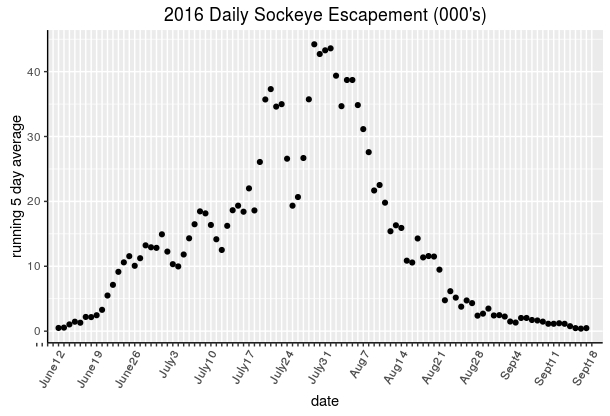 mes from a family with a long history of Skeena river fishing.
One hour long sets are made on both high and low water slack during daylight hours (occasionally four sets in one day). Daily escapement estimates are calculated based on catch per hour. Some of the fish are also weighed, measured, and portions are stored for later scale and DNA analysis.
All energy level readings at the Tyee Test fishery site were performed by the same operator, Stephanie Spencer. Data collection was somewhat opportunistic: operator availability, size of the catch and the fact the Tyee Test fishery is a busy place all came into play. However being able to piggyback on the Tyee Test fishery made the Skeena Salmon Energy Monitoring Progarm cost effective—we didn’t have to catch the fish and we were allowed to combine our lipid level readings with the Tyee Test fishery data.
Measuring the fish
Measurements were made with a handheld microwave energy meter (Distell Fish Fatmeter model 692, Distel, West Lothian, Scotland). The procedure recommended by the manufacturer was followed. Before beginning a series of tests the instrument was turned on and allowed to stabilize for 5 minutes. It was checked using check pads provided and then set to the calibration for the species. Excess moisture was wiped off the fish to be sampled and it was measured on four positions just above the lateral line: P1, just posterior of the gill cover; P2, just anterior of the leading edge of the dorsal fin; P3, directly below the dorsal fin; and P4, midway between the dorsal and adipose fins. The meter then presents the average of the four readings. Each fish took less than 30 seconds to measure and the process is non-destructive.
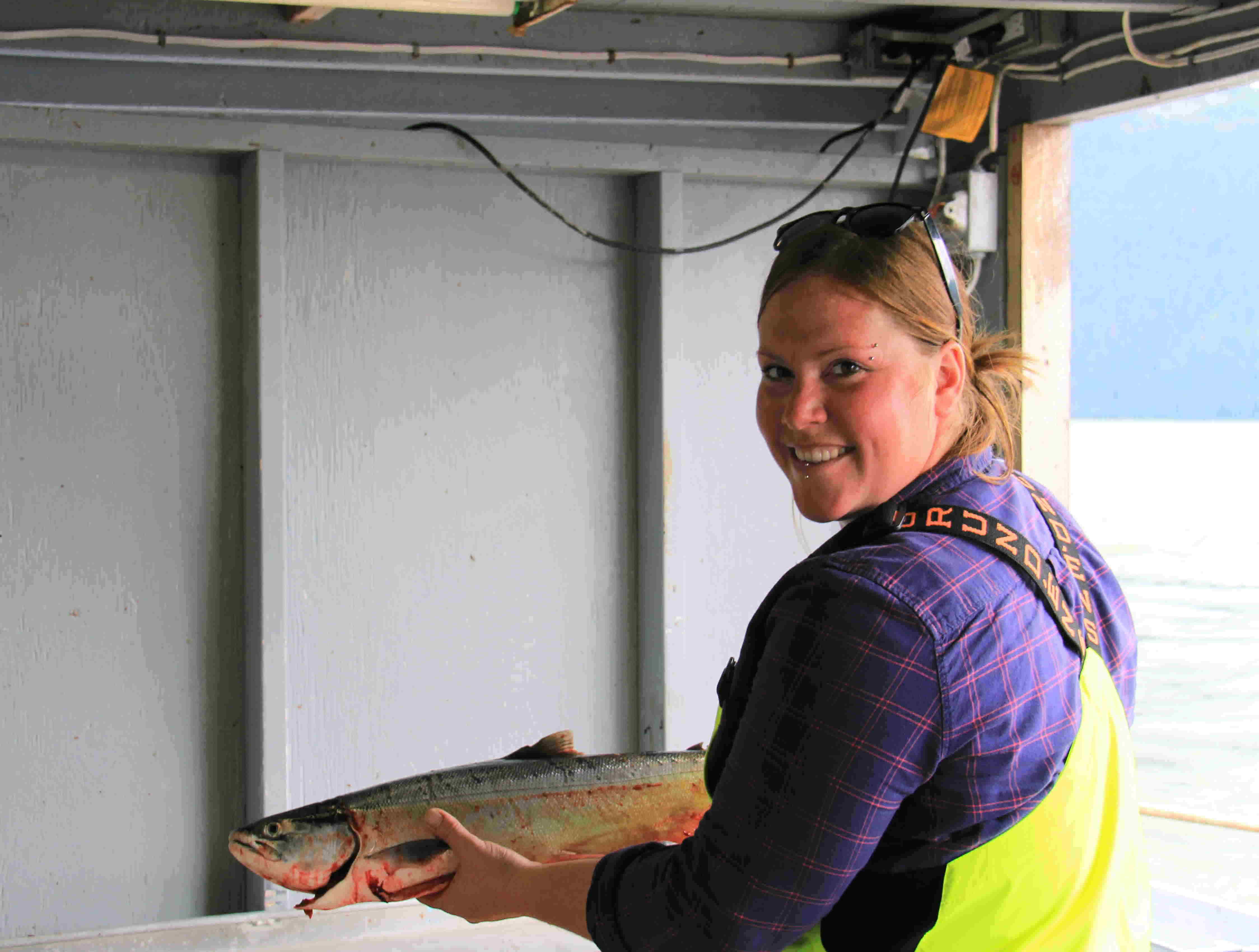
Fisheries technician Stephanie Spencer
The average along with the time, date, calibration setting, results of check pads, visual observations and comments were recorded by pen and paper. Also, when available, length (nose to fork), weight, and dfo DNA identification number were recorded for each fish sampled. Later, the content of the memory stored in the meter was downloaded onto a PC, entered into spreadsheet, and the individual readings of positions recovered. Positions “P1” and “P2” were used to calculate gross lipid.
Calculating the gross somatic lipid
The Distell Meter is used by the food industry to measure fat content in fillets of salmon. Here we are interested in whole body lipid levels. Several researchers have developed calibrations so that the instrument can be used to determine whole body lipid levels and recently the meter has found utility in the fields of salmon energetics and conservation physiology.
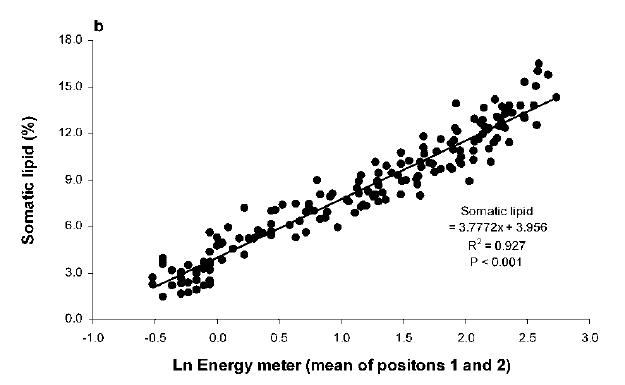
“Relationship of percentage somatic lipid to log e transformed energy meter readings (average of positions 1 and 2)” Crossin, G.T. and Hinch, S.G.
We used the relationship between whole body lipid concentration determined by laboratory analysis and the average of meter readings P1 and P2 as calculated by G.T. Crossin and S.G. Hinch (see ref.) for sockeye salmon.
Gross somatic lipid = 3.7772 x ln((P1+P2)/2) + 3.956.
*Graphs for the website were generated using the R statistics program.
References
Colt, J. and Shearer, K. (2001). Evaluation of the use of the torry fish fatmeter to nonlethally estimate lipid in adult salmon. Report of Research to the US Army Corps of Engineers, Portland District, Contract Report. W66QKZ00805700, Seattle.
Crossin, G. T. and Hinch, S. G. (2005). A nonlethal, rapid method for assessing the somatic energy content of migrating adult pacific salmon. Transactions of the American Fisheries Society, 134(1):184–191.
Kent, M. (1990). Hand-held instrument for fat/water determination in whole fish. Food Control, 1(1):47–53.
R Core Team (2016). R: A Language and Environment for Statistical Computing. R Foundation for Statistical Computing, Vienna, Austria. ISBN 3-900051-07-0, URL <http://www.R-project.org/>.